If you have ever sent a long message and got a reply that says just “K”, you may have felt confused.
Is it okay?
Is the person angry?
Is it rude?
Or is it just short for something?
In this complete guide, you will learn:
- The simple meaning of K in text
- The tone behind it
- Where it came from
- Real-life examples with short dialogues
- Personality clues
- Common mistakes
- Modern 2026 texting trends
- FAQs people search online
Let’s break it down in very easy words.
What Does “K” Mean in Text?
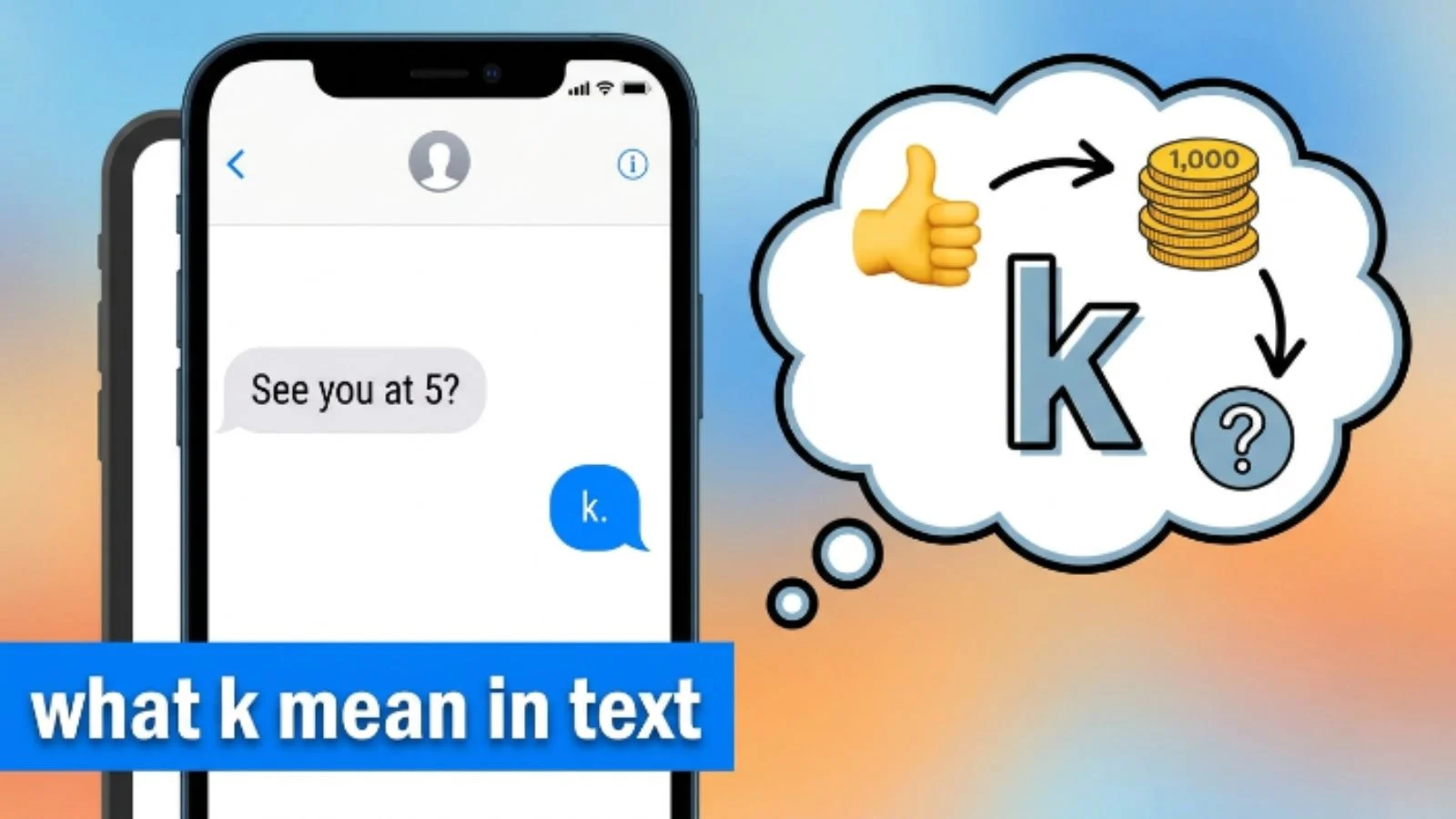
The short answer is simple:
“K” means “Okay.”
It is a very short way to say:
- Okay
- Alright
- I understand
- Got it
People use K to reply quickly in messages.
It is one of the shortest replies in texting.
Simple Definition (For Beginners)
K = A very short way to say “Okay.”
That’s it.
But here is the important part:
The tone can change the meaning.
Sometimes it is normal.
Sometimes it feels cold.
Sometimes it feels rude.
Context matters.
Why Do People Use “K” Instead of “OK”?
People like texting fast.
In modern chat culture, especially on:
- Snapchat
- Messenger
- SMS
- TikTok DMs
Short replies are common.
Typing “K” is faster than typing “OK.”
It saves one letter.
That may sound small. But in fast texting, small things matter.
The Origin and History of “K” in Texting
To understand K, we must understand OK first.
The word OK became popular in the 1800s in the United States. It was used in newspapers as a funny short form of “oll korrect,” which meant “all correct.”
Over time, OK became one of the most used words in the world.
Then texting started.
When mobile phones became popular in the 1990s and early 2000s:
- People had small keypads
- Typing was slow
- Messages cost money
So people shortened words.
For example:
- You → U
- See you → CU
- Okay → K
This is how K became common in digital communication.
By 2026, it is still used — but now tone matters more.
Is “K” Rude in Text?
This is the big question.
The answer: It depends.
Sometimes K is neutral.
Sometimes it feels rude.
Sometimes it feels angry.
Let’s understand why.
Tone of “K” in Different Situations
Here is a simple table to help you understand:
| Situation | Meaning of K | Tone |
|---|---|---|
| Friend confirms plan | Okay | Neutral |
| Parent replying to child | Got it | Neutral |
| After an argument | Fine | Cold or annoyed |
| Short reply after long message | Not interested | Possibly rude |
| Busy person replying | I saw it | Practical |
As you can see, tone depends on context.
Real-Life Examples With Short Dialogues
Each example includes a short explanation to help beginners.
1. Neutral Use
A: “I’ll meet you at 5 PM.”
B: “K.”
Meaning: B agrees.
Explanation: This is a simple confirmation.
2. Friendly Use
A: “Movie night tonight?”
B: “K sounds good!”
Meaning: Yes.
Explanation: Adding extra words makes it friendly.
3. Cold Reply
A: “I’m sorry I forgot your birthday.”
B: “K.”
Meaning: I am upset.
Explanation: One-letter reply after an apology feels cold.
4. Busy Person
Boss: “Send the file before 3.”
Employee: “K.”
Meaning: I understand.
Explanation: Short reply during work can be efficient.
5. Argument Situation
A: “Fine, do whatever you want.”
B: “K.”
Meaning: I don’t care anymore.
Explanation: Here it may show frustration.
Personality Traits Linked to “K” Users
While not always true, people who often use “K” may be:
- Direct
- Short with words
- Busy
- Emotionally distant
- Not expressive
- Minimalist in texting
But remember:
Some people just type fast.
Do not judge too quickly.
When “K” Feels Positive
K feels positive when:
- Conversation is casual
- Both people use short replies
- No emotional topic is discussed
- It is used in work chats
Example:
A: “Got the tickets.”
B: “K thanks.”
This feels normal.
When “K” Feels Negative
K may feel negative when:
- You send a long emotional message
- You apologize
- You share good news
- You expect excitement
Example:
A: “I got promoted!”
B: “K.”
This feels uninterested.
Difference Between K, OK, and Okay
Let’s compare.
| Word | Length | Tone | Feeling |
|---|---|---|---|
| K | 1 letter | Short | Can feel cold |
| OK | 2 letters | Neutral | Safe |
| Okay | 4 letters | Friendly | Warm |
In 2026 texting culture:
- Okay feels warmer
- OK feels normal
- K feels shortest and sometimes dry
Modern Usage in 2026
In 2026, texting is more emotional.
People now use:
- Voice notes
- Emojis
- GIFs
- Stickers
Because of this, a simple “K” may feel more serious than before.
Many Gen Z and Gen Alpha users think:
“K = Dry energy.”
“Dry energy” means low emotion.
So people now prefer:
- “Okayy”
- “Okk”
- “Kk”
- “Alright”
These feel softer.
Common Variations of K
Here are modern versions:
1. Kk
Means okay.
Explanation: Repeating makes it softer.
2. K.
Means okay, but serious.
Explanation: The period makes it feel strict.
3. Kk fine
Means agreement but maybe annoyed.
Explanation: Extra word changes tone.
4. K thx
Means okay thanks.
Explanation: Polite and short.
Common Mistakes About “K”
Many people misunderstand K.
Here are common myths.
Mistake 1: K Always Means Angry
Not true.
Sometimes the person is just busy.
Mistake 2: K Means Breakup
Not always.
But during fights, it can show distance.
Mistake 3: Older People Don’t Use K
They do.
But younger users use it more casually.
Mistake 4: K Is Always Rude
Wrong.
Tone depends on context.
When Should You Avoid Using “K”?
Avoid using K when:
- Someone shares emotional news
- Someone apologizes
- Someone shares exciting news
- You want to sound warm
Instead, say:
- “Okay, I understand.”
- “That’s great!”
- “I’m happy for you.”
- “Thanks for telling me.”
This builds better connection.
Social Media and “K”
On platforms like:
- Snapchat
“K” often means:
- Message received
- End of conversation
- No further comment
It may signal the chat is closing.
Psychological Meaning of Short Replies
Short replies like “K” can show:
- Emotional distance
- Low energy
- Disinterest
- Or simply efficiency
Human brains read tone even in text.
That is why “K” feels stronger than it looks.
How to Respond If Someone Sends You “K”
Here are options:
1. Ignore It
If topic is small.
2. Ask Politely
“Everything okay?”
3. Continue Talking
If conversation is not serious.
4. Give Space
If there was tension.
Do not overthink small replies.
Generational Differences
Millennials
Use K casually.
Gen Z
Often see K as dry or cold.
Gen Alpha (2026 teens)
Prefer expressive text.
Language changes with time.
Cultural Differences
In some cultures:
- Short replies are normal.
- Direct communication is common.
In others:
- Warm replies are expected.
So context and culture matter.
Quick Summary List
Here is everything in short:
- K means Okay
- It is very short
- Tone depends on situation
- Can feel neutral or cold
- Origin comes from texting culture
- Best used in casual or work chats
- Avoid in emotional conversations
Frequently Asked Questions
1. What does K mean from a girl?
It usually means okay.
But if the topic is emotional, it may mean she is upset or annoyed.
2. What does K mean from a guy?
Same meaning — okay.
But during arguments, it can show frustration or distance.
3. Is K passive-aggressive?
Sometimes.
If used after a long emotional message, it may feel passive-aggressive.
4. Why do people reply with just K?
To save time.
Or because they do not want to continue the conversation.
5. Is it better to say OK instead of K?
Yes, if you want to sound warmer.
OK feels more neutral and safe.
6. What does K with a period mean?
“K.” feels serious or cold.
The period adds firmness.
7. Does K mean the conversation is over?
Often yes.
It can signal closure in chat.
Final Thoughts
Now you clearly understand what K means in text. It is a short form of “okay.” But tone changes everything. In casual chats, it is normal. In emotional talks, it may feel cold. Texting in 2026 is more expressive, so one-letter replies can feel stronger than before. Always think about context before reacting. If you want to sound kind, use warmer words. Communication is not just about words. It is about feelings. Small letters can carry big meaning. Use K wisely. And next time you receive it, pause before assuming the worst.