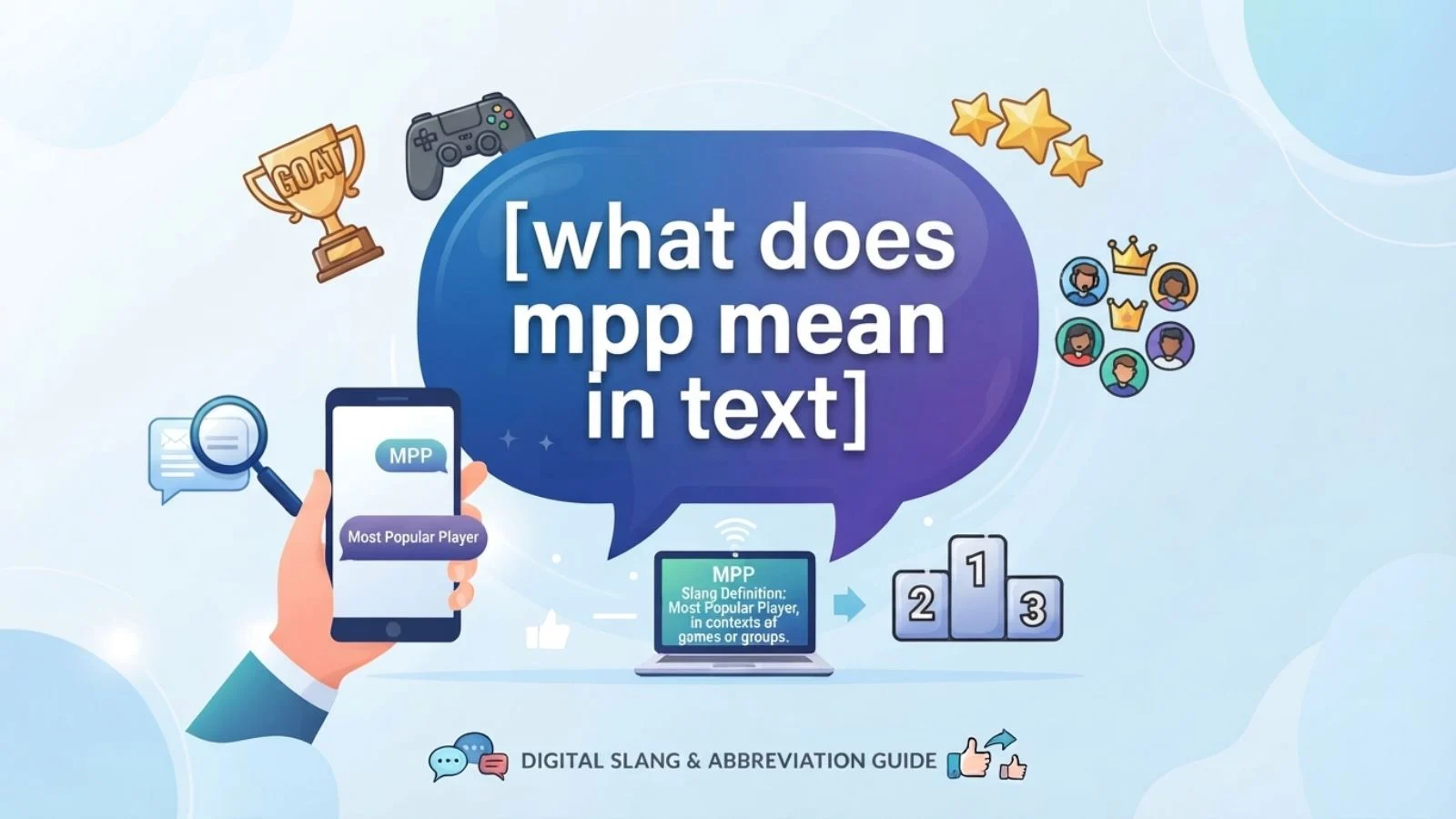
Ever received a text saying “MPP” and wondered what the person was trying to say? You are not alone. MPP is not one of those texting abbreviations with one universally accepted meaning. Its meaning can change depending on the conversation, platform, and people using it.
In casual online conversations, MPP can have niche slang meanings, while in professional, academic, or technical contexts, it can mean something completely different. The key is to look at the surrounding message before deciding what someone means.
What Does MPP Mean in Text?
MPP does not have one standard meaning in everyday texting. One slang definition recorded online is “Maybe, Possibly, Perhaps,” which can be used as a deliberately vague response. However, this is a niche usage rather than a universally recognized texting abbreviation.
For example:
“Are you coming with us tonight?”
“MPP.”
In this context, the person could be using MPP to mean “Maybe, possibly, perhaps,” essentially saying they are unsure.
However, context matters because MPP has many established meanings outside casual texting. Dictionaries and reference sources list meanings such as Member of Provincial Parliament, Massively Parallel Processing, and Master of Public Policy.
Simple Meaning of MPP
In a casual slang context, MPP can mean “Maybe, Possibly, Perhaps.”
In simple English, it expresses uncertainty. The person does not want to give you a definite yes or no.
You might understand it as:
- Maybe
- Possibly
- Perhaps
- I am not sure
- It could be
- I haven’t decided yet
For example:
Person 1: “Are you going to the party?”
Person 2: “MPP.”
Here, MPP could mean:
“Maybe, possibly, perhaps. I haven’t decided.”
Because this slang meaning is not universal, you should not automatically assume it every time you see MPP.
Where Is MPP Used?
The slang use of MPP may appear in informal digital conversations, especially when people use unusual abbreviations or inside jokes.
You might encounter an abbreviation like this in:
- Text messages
- Private chats
- Social media conversations
- Online communities
- Gaming chats
- Group conversations
- Informal DMs
However, MPP is not as universally recognized as common abbreviations such as LOL, BRB, OMG, or IDK.
That means the person you’re talking to may have created their own meaning for it or may be using a niche community-specific definition.
If the message does not make sense, the easiest solution is simply to ask:
“What do you mean by MPP?”
That can prevent an unnecessary misunderstanding.
Why Do People Use MPP?
People often use abbreviations because they make conversations faster and more casual.
If someone uses MPP to mean “Maybe, Possibly, Perhaps,” it can communicate uncertainty without writing a complete sentence.
For example:
“Are you free tomorrow?”
Instead of:
“Maybe, possibly, perhaps. I haven’t decided yet.”
Someone might simply reply:
“MPP.”
There can also be a playful element to using an unusual abbreviation. Friends sometimes develop their own shorthand that makes sense only within their group.
This is why the same abbreviation can mean different things to different people.
MPP Meaning in Different Contexts
The most important thing to remember is that MPP is highly context-dependent.
Here are some possible interpretations:
| Context | Possible Meaning |
|---|---|
| Casual slang | Maybe, Possibly, Perhaps |
| Canadian politics | Member of Provincial Parliament |
| Computing | Massively Parallel Processing |
| Education | Master of Public Policy |
| Electronics | Maximum Power Point |
| Other specialized contexts | Several technical or organizational meanings |
MPP is officially used for Member of Provincial Parliament in Canadian English, particularly in Ontario. Oxford and Collins both list this meaning.
Reference sources also list Massively Parallel Processing and Master of Public Policy among MPP’s established meanings.
So, if you see MPP in a casual text, do not immediately assume it refers to one particular slang phrase.
Examples of MPP in Text
Here are some examples showing how the slang interpretation might work.
Example 1: Making Plans
Friend: “Are you coming to dinner tonight?”
You: “MPP.”
Here, MPP could mean:
“Maybe, possibly, perhaps.”
The person has not made a final decision.
Example 2: Going to a Party
Friend: “You going to Sarah’s party?”
You: “MPP, depends on my parents.”
The person is saying that attending is possible, but not certain.
Example 3: Weekend Plans
Person 1: “Are you free Saturday?”
Person 2: “MPP. I might have plans.”
In this conversation, MPP communicates uncertainty.
Example 4: Asking About an Event
Friend: “Do you think Jake will come?”
You: “MPP.”
The response suggests:
“Maybe. It is possible, but I don’t know.”
Example 5: A Playful Conversation
Friend: “Did you finish your homework?”
You: “MPP.”
Depending on the relationship, this could be a playful or deliberately vague answer rather than a serious abbreviation.
MPP vs Similar Terms
If someone uses MPP to express uncertainty, several more familiar expressions can communicate a similar idea.
| Term | Meaning | Tone |
|---|---|---|
| MPP | Maybe, Possibly, Perhaps | Very informal/niche |
| Maybe | Something might happen | Neutral |
| IDK | I Don’t Know | Casual |
| Perhaps | Maybe | More formal |
| Possibly | Something could happen | Neutral |
| TBD | To Be Determined | Informal/organizational |
| Not sure | Uncertain | Clear and direct |
The main difference is recognition.
“Maybe” and “not sure” are immediately understood by almost everyone. MPP may require context because it is not a universally established texting abbreviation.
When Should You Use MPP?
If you know that your friends or online community understand MPP, you can use it in an informal conversation.
It may work when:
- You are chatting with close friends.
- Your group already uses the abbreviation.
- You are having a playful conversation.
- The meaning is obvious from the context.
- You want to give a deliberately uncertain answer.
For example:
“Are you joining us later?”
“MPP.”
This can work if everyone in the conversation understands the abbreviation.
However, avoid using unfamiliar slang when clarity is important.
For work emails, school assignments, formal messages, or professional conversations, it is usually better to write “maybe,” “possibly,” or “I’m not sure.”
Common Misunderstandings About MPP
One of the biggest problems with MPP is that it has multiple meanings.
A person searching for “what does MPP mean in text” may expect one simple definition, but the abbreviation can refer to very different things.
MPP Does Not Always Mean “Maybe”
The slang definition “Maybe, Possibly, Perhaps” exists online, but it is not the only meaning associated with MPP.
If you see MPP in a conversation about Canadian government, for example, it may refer to a Member of Provincial Parliament.
MPP Is Not a Common Universal Texting Acronym
Unlike “LOL” or “OMG,” MPP is not universally understood as one standard texting expression.
This means context is extremely important.
Capitalization Does Not Solve Everything
You might see MPP, mpp, or another variation. Capitalization alone does not necessarily tell you which meaning the sender intends.
Look at the words around the abbreviation instead.
How to Figure Out What MPP Means in a Message
If someone sends you MPP and you are confused, use the surrounding conversation as your first clue.
Ask yourself:
- What were we talking about?
- Was the person answering a question?
- Does “Maybe, Possibly, Perhaps” make sense there?
- Are we discussing school, work, politics, technology, or another specific subject?
- Does the sender normally use unusual slang?
For example:
“Are you coming tomorrow?” — “MPP.”
The slang interpretation may make sense because the response relates directly to uncertainty.
But:
“The MPP spoke at the provincial parliament today.”
Here, the context clearly points toward Member of Provincial Parliament, not texting slang.
Pro Tips for Understanding MPP
1. Read the entire conversation.
Never interpret an abbreviation by looking at three letters alone.
2. Consider the relationship.
Friends may use personal slang that strangers do not understand.
3. Look for the topic.
A technology conversation and a casual chat can give MPP completely different meanings.
4. Ask when you’re unsure.
There is nothing wrong with saying, “What does MPP mean here?”
5. Avoid unfamiliar abbreviations in formal writing.
Clear language is usually better than confusing shorthand.
6. Don’t assume every online definition is widely used.
Some slang definitions come from niche communities or individual users. MPP’s online slang entries illustrate how different interpretations can exist.
Is MPP a Good Way to Say “Maybe”?
It can be used that way in a niche or informal context, but “maybe” is much clearer.
If your goal is to make sure the other person understands you, saying:
“Maybe, I’m not sure yet.”
is safer than simply writing:
“MPP.”
The abbreviation may be understood by one person and completely confusing to another.
That is especially true when you’re talking to someone you do not know well.
Final Thoughts
So, what does MPP mean in text? In one online slang usage, it means “Maybe, Possibly, Perhaps” and expresses uncertainty. However, MPP has many other established meanings, so the surrounding conversation is essential for understanding what the sender intended.
If someone sends you “MPP” in a casual chat and the meaning is unclear, simply ask for clarification. A little context can completely change what these three letters mean.
FAQ About MPP in Text
What does MPP mean in texting?
In one informal slang usage, MPP means “Maybe, Possibly, Perhaps.” It can be used when someone is uncertain or does not want to give a definite answer. This is a niche usage, so context matters.
Is MPP a common texting abbreviation?
No. MPP is not a universally recognized texting abbreviation like LOL, BRB, or IDK. Different people and communities may use it differently.
What does MPP mean in Canada?
In Canadian English, MPP commonly means “Member of Provincial Parliament,” particularly in Ontario.
Can MPP have other meanings?
Yes. MPP has several meanings in different fields, including Massively Parallel Processing, Master of Public Policy, and Maximum Power Point.