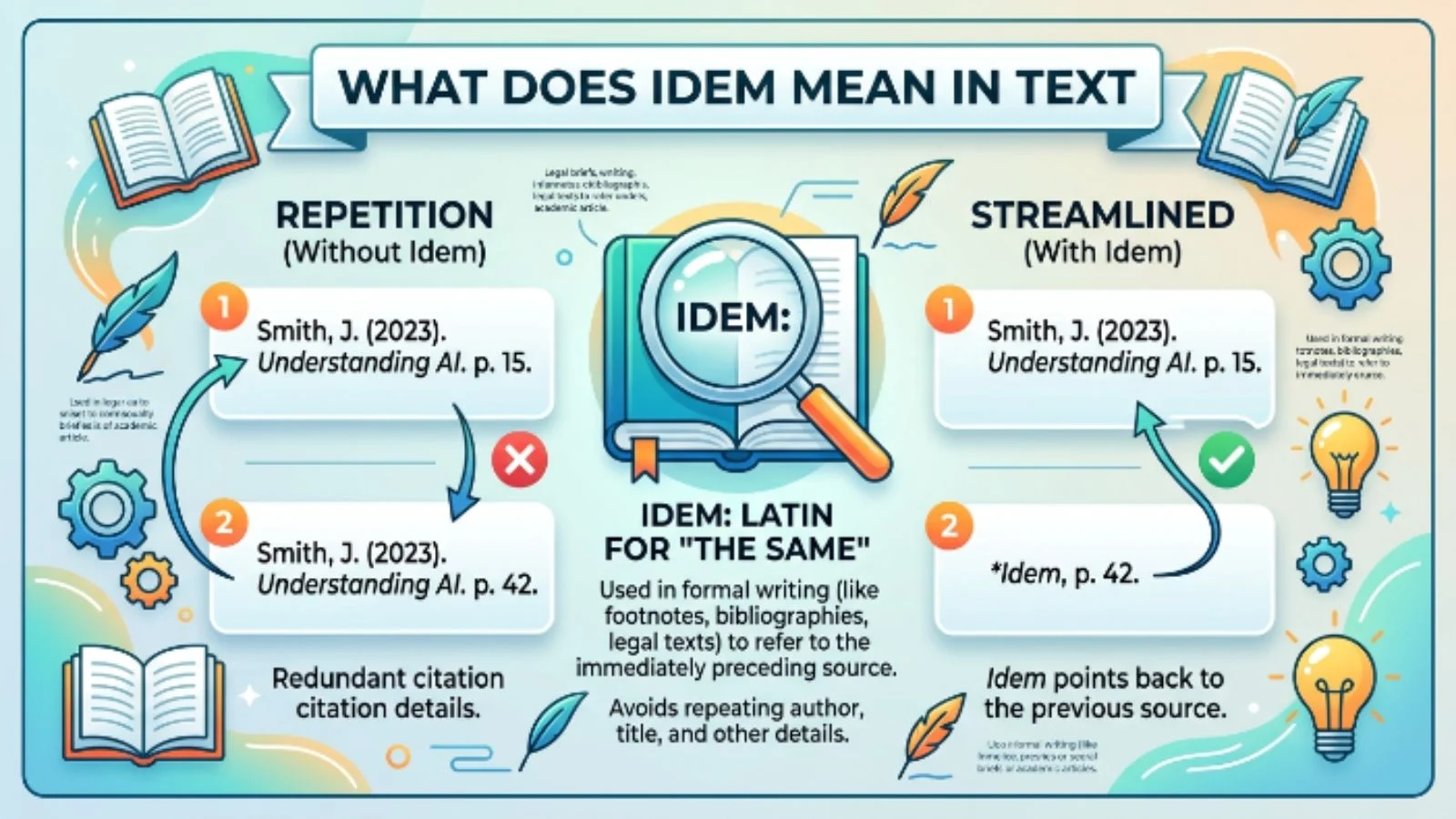
“Idem” is a word people use to say “same,” “me too,” or “I agree.”
When someone says something and another person replies with “idem,” they mean they feel the same way.
It is a short and simple response often used in:
- Text messages
- Social media comments
- Online chats
- School or work discussions
- Casual conversations
Simple Definition
Idem = Same thing / Same here / I feel the same
It is similar to saying:
- “Me too”
- “Same”
- “I agree”
- “Likewise”
Quick Example
Person 1: “I’m tired after work.”
Person 2: “Idem.”
What does it mean?
Person 2 is saying they are tired too.
How Do People Use “Idem” in Text?
People usually use “idem” as a quick reply. It saves time and avoids repeating the same sentence.
Common Situations
| Situation | Meaning of “Idem” |
|---|---|
| Someone shares a feeling | “I feel the same” |
| Someone gives an opinion | “I agree” |
| Someone describes a problem | “Same problem here” |
| Someone talks about plans | “I want that too” |
Is “Idem” a Slang Word?
Not exactly.
“Idem” is actually an old Latin word, but today many people use it casually online like internet slang.
So it is:
- A real word
- A formal Latin term
- Sometimes used casually in texting
Origin and History of “Idem”
The word “idem” comes from the Latin language.
In Latin, “idem” means:
- “The same”
- “Identical”
- “That same thing”
For hundreds of years, scholars, writers, and legal experts used the word in books and documents.
Later, people started using it in casual writing and online conversations because it is short and easy.
Historical Use
In older writing, “idem” was common in:
- Academic papers
- Legal documents
- Religious texts
- Research notes
Today, it appears more often in:
- Social media
- Group chats
- Messaging apps
- Meme culture
Why Do People Say “Idem” Instead of “Same”?
People use “idem” because it can sound:
- Smarter
- More stylish
- More unique
- More playful
- More educated
Some users also enjoy using uncommon words online.
Example
Person 1: “Pizza is the best comfort food.”
Person 2: “Idem.”
Explanation
The second person agrees completely and uses “idem” instead of “same.”
How to Pronounce “Idem”
Most people pronounce it like:
Eye-dem
Some may also say:
Ee-dem
Both pronunciations are commonly understood in casual conversation.
Real-Life Text Examples of “Idem”
Example 1: Feeling Tired
A: “I barely slept last night.”
B: “Idem.”
Explanation
Person B also did not sleep well.
Example 2: Loving a TV Show
A: “I’m obsessed with this series.”
B: “Idem!”
Explanation
Person B loves the series too.
Example 3: School Stress
A: “This homework is impossible.”
B: “Idem.”
Explanation
Both students think the homework is hard.
Example 4: Weekend Plans
A: “I just want to sleep all weekend.”
B: “Idem honestly.”
Explanation
The second person wants the same thing.
Example 5: Food Cravings
A: “I need burgers right now.”
B: “Idem.”
Explanation
Person B wants burgers too.
Short Dialogues Using “Idem”
Friends Chatting
Sarah: “I miss summer vacation.”
Lina: “Idem.”
Explanation
Lina feels the same way.
Online Gaming Chat
Player 1: “This level is too hard.”
Player 2: “Idem bro.”
Explanation
Both players think the game level is difficult.
Office Conversation
Worker 1: “I need coffee badly.”
Worker 2: “Idem.”
Explanation
Both workers are tired and want coffee.
Different Meanings Based on Context
Even though “idem” usually means “same,” the exact feeling changes depending on the conversation.
| Context | Meaning |
|---|---|
| Emotional talk | “I feel the same” |
| Opinion | “I agree” |
| Complaint | “Same problem here” |
| Excitement | “I want that too” |
| Joke | “That happened to me too” |
Personality Traits of People Who Use “Idem”
People who use “idem” online are often seen as:
Educated
They may enjoy using unusual or smart words.
Minimalist
They like short replies instead of long messages.
Trend-Aware
Some people use it because it became trendy online.
Playful
Using “idem” can sound fun or dramatic in chats.
Socially Active
The word appears often in active group chats and social media spaces.
Is “Idem” Formal or Informal?
It can be both.
Formal Usage
In older academic or legal writing, “idem” is formal.
Informal Usage
In texting and social media, it is casual and relaxed.
Modern Usage of “Idem” in 2026
In 2026, “idem” is becoming more visible online because users enjoy short and aesthetic responses.
Popular Places Where It Appears
- TikTok comments
- Instagram replies
- Snapchat chats
- Discord servers
- WhatsApp groups
- X posts
- YouTube comments
Example of Modern Usage
Comment: “I’m mentally still in 2024.”
Reply: “Idem.”
Explanation
The reply means the person relates to the feeling.
Why Gen Z and Gen Alpha Use “Idem”
Young internet users like words that are:
- Short
- Clever
- Different
- Easy to type
- Trendy
“Idem” fits all of these trends.
It also feels more interesting than simply saying “same.”
Similar Words and Alternatives to “Idem”
Here are other words people use with similar meanings.
| Word | Meaning |
|---|---|
| Same | I agree |
| Me too | I feel the same |
| Likewise | Same here |
| Facts | True |
| Relatable | I understand |
| Mood | Same feeling |
| Literally | Strong agreement |
Example Comparison
A: “I hate waking up early.”
Replies:
- “Same”
- “Me too”
- “Idem”
- “Mood”
Explanation
All replies show agreement.
Is “Idem” Grammatically Correct?
Yes.
“Idem” is a real word with historical roots in Latin.
However, in casual texting, grammar rules are usually relaxed.
Can “Idem” Be Used Alone?
Yes.
Most people use it as a one-word reply.
Example
A: “I’m hungry.”
B: “Idem.”
This is completely normal in texting.
Can “Idem” Sound Rude?
Usually no.
But very short replies can sometimes feel cold if the conversation is emotional.
Example
A: “I had a terrible day.”
B: “Idem.”
Explanation
The reply may sound less caring because it is very brief.
In emotional situations, longer responses are often better.
Funny and Relatable Uses of “Idem”
People also use “idem” humorously online.
Example
Post: “I opened my phone for 5 minutes and lost 3 hours.”
Comment: “Idem.”
Explanation
The commenter relates to the funny experience.
Common Mistakes About “Idem”
Mistake 1: Thinking It Means “Item”
Some people confuse “idem” with “item.”
These words are completely different.
| Word | Meaning |
|---|---|
| Idem | Same |
| Item | Object or thing |
Mistake 2: Using It in Serious Professional Emails
“Idem” may sound too casual or unclear in professional emails.
Instead, use:
- “I agree”
- “Likewise”
- “Same here”
Mistake 3: Overusing It
Using “idem” too often can make conversations repetitive.
Balance it with natural replies.
Mistake 4: Mispronouncing It
Some people say it incorrectly because they have only read it online.
The common pronunciation is:
- Eye-dem
When Should You Use “Idem”?
Use it when:
- You agree with someone
- You share the same feeling
- You want a quick response
- The conversation is casual
When Should You Avoid “Idem”?
Avoid it in:
- Formal business emails
- Academic essays
- Professional interviews
- Serious emotional conversations
Social Media Examples in 2026
Example 1
Post: “Adult life is just being tired all the time.”
Comment: “Idem.”
Explanation
The commenter relates strongly.
Example 2
Post: “I need a vacation immediately.”
Reply: “Idem honestly.”
Explanation
The person also wants a vacation badly.
Example 3
Post: “Why is food so expensive now?”
Reply: “Idem. Everything costs too much.”
Explanation
The second person agrees about rising prices.
Cultural Popularity of “Idem”
“Idem” became more popular because internet users enjoy mixing:
- Smart words
- Meme culture
- Minimal texting
- Aesthetic language
Short replies became trendy on social platforms, and “idem” matched that style perfectly.
Emotional Tone of “Idem”
The tone depends on the conversation.
| Tone | Example |
|---|---|
| Funny | “Idem lol” |
| Serious | “Idem.” |
| Friendly | “Idem bestie” |
| Dramatic | “Idem honestly” |
| Relaxed | “Idem haha” |
Is “Idem” Popular Worldwide?
Yes, especially among people who:
- Speak multiple languages
- Use internet slang often
- Enjoy modern online culture
Because Latin influenced many languages, some users already recognize the word naturally.
How “Idem” Differs From “Ditto”
Many people compare “idem” and “ditto.”
Both mean “same.”
Difference
| Word | Style |
|---|---|
| Idem | More intellectual or trendy |
| Ditto | More casual and older-fashioned |
Example
A: “This weather is awful.”
B: “Ditto.”
C: “Idem.”
Explanation
Both replies mean the same thing.
Can Adults Use “Idem”?
Absolutely.
Even though younger users helped popularize it online, anyone can use it.
It works for:
- Teens
- College students
- Adults
- Professionals in casual chats
Does “Idem” Have Romantic Meaning?
Not directly.
But it can appear in romantic conversations.
Example
A: “I miss you.”
B: “Idem.”
Explanation
The second person also misses them.
Is “Idem” Still Trending in 2026?
Yes.
Short-response culture continues to grow online, and “idem” remains popular in:
- Messaging apps
- Meme replies
- Social media comments
- Online communities
People like concise communication, and “idem” fits modern texting habits.
Quick Summary Table
| Question | Answer |
|---|---|
| What does idem mean? | Same / Me too |
| Is it slang? | Partly |
| Origin | Latin |
| Formal or casual? | Both |
| Common online? | Yes |
| Popular in 2026? | Yes |
| Can it be used alone? | Yes |
FAQs About “What Does Idem Mean in Text?”
What does “idem” mean in texting?
It means “same,” “me too,” or “I agree.”
Is “idem” a real word?
Yes. It comes from Latin and has existed for centuries.
Why do people use “idem” online?
People use it because it is short, trendy, and stylish.
Is “idem” formal?
Historically yes, but in modern texting it is mostly casual.
Can I use “idem” instead of “same”?
Yes. In casual chats, both words work similarly.
Is “idem” rude?
Usually no. But in emotional conversations, longer replies may sound kinder.
How do you pronounce “idem”?
Most people say it as “eye-dem.”
Conclusion
Now you know the answer to the question, “what does idem mean in text?” In simple words, “idem” means “same,” “me too,” or “I agree.” The word comes from Latin, but today it is widely used in texting, social media, and online conversations. People like it because it is short, modern, and expressive. Whether you see it in a TikTok comment, a WhatsApp message, or a group chat, the meaning is usually about sharing the same feeling or opinion. Learning internet language like “idem” can help you understand modern communication better and feel more confident online.