Have you ever received a message that simply said “DC” and wondered what it meant?
You’re not alone.
Texting slang changes fast, and abbreviations often have multiple meanings depending on the conversation. While some text shortcuts are easy to understand, DC can be confusing because it is used in several different ways across texting, social media, gaming, and online chats.
In this guide, you’ll learn exactly what DC means in text, when people use it, how to respond, and the most common situations where you’ll see it.
What Does DC Mean in Text?
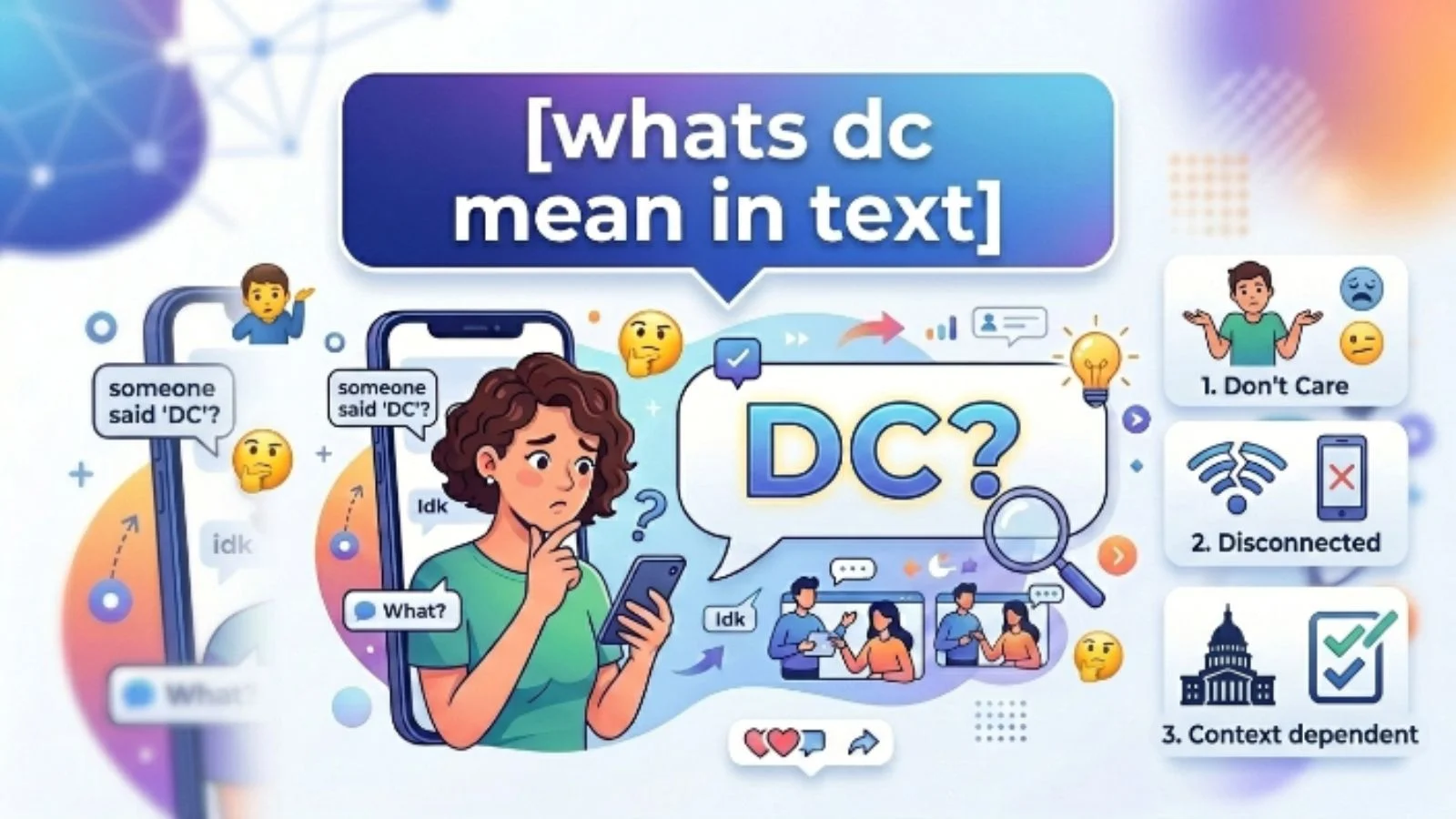
DC most commonly means “Don’t Care” in texting.
People use it when they are not concerned about something or when they have no preference regarding a decision.
Quick Definition
DC = Don’t Care
It is a casual abbreviation used in text messages, online chats, and social media conversations.
Example:
Person A: “Do you want pizza or burgers?”
Person B: “DC, whatever you want.”
In this example, Person B is saying they have no preference and are happy with either option.
Simple Meaning of DC
In simple words, DC means that something does not matter much to the person using it.
It can express:
- No preference
- Lack of concern
- Indifference
- Agreement with any option
Think of it as a shorter way of saying:
- “I don’t mind.”
- “It’s up to you.”
- “Whatever works.”
- “I don’t care.”
Where Is DC Used?
You can find DC in many online conversations.
Text Messages
Friends often use DC when discussing plans.
Example:
“Which movie should we watch?”
“DC. You choose.”
Social Media
People use DC in comments, direct messages, and group chats.
Example:
“Want to meet at 5 or 6?”
“DC.”
Gaming Chats
Gamers frequently use short abbreviations to communicate quickly.
Example:
“Which map do you want?”
“DC.”
Group Conversations
When multiple people are making a decision, someone might respond with DC to show they are okay with any choice.
Why Do People Use DC?
There are several reasons why people use this abbreviation.
It Saves Time
Typing two letters is much faster than writing “I don’t care.”
It Feels Casual
Text conversations are usually informal, so abbreviations fit naturally.
It Keeps Conversations Moving
When someone has no strong opinion, using DC quickly lets others make the decision.
It Is Widely Understood
Many internet users recognize DC as shorthand for “Don’t Care.”
Real-Life Examples of DC in Text
Understanding examples makes the meaning much clearer.
Example 1: Choosing Food
Friend: “Chinese or Italian?”
You: “DC.”
Meaning: Either option is fine.
Example 2: Making Plans
Friend: “Should we meet Friday or Saturday?”
You: “DC, both work.”
Meaning: You have no preference.
Example 3: Selecting a Movie
Friend: “Action movie or comedy?”
You: “DC.”
Meaning: You’re happy with either choice.
Example 4: Group Project
Classmate: “Should we present first or last?”
You: “DC.”
Meaning: The order doesn’t matter to you.
Other Meanings of DC in Text
Although Don’t Care is the most common texting meaning, DC can have other meanings depending on the context.
DC = Disconnect
In gaming and online communication, DC may mean Disconnect or Disconnected.
Example:
“He DC’d during the match.”
Meaning: He lost connection or left the game.
DC = Discord
Some people use DC as a short form of the popular communication platform Discord.
Example:
“Send me the link on DC.”
Meaning: Send it through Discord.
DC = Washington, D.C.
In conversations about locations, DC may refer to the capital of the United States.
Example:
“I’m visiting DC next month.”
Meaning: Washington, D.C.
Context usually makes the intended meaning obvious.
DC vs Similar Text Terms
| Term | Meaning | Usage |
|---|---|---|
| DC | Don’t Care | No preference |
| IDC | I Don’t Care | Stronger expression |
| IDK | I Don’t Know | Lack of knowledge |
| IMO | In My Opinion | Sharing an opinion |
| TBH | To Be Honest | Being truthful |
| NVM | Never Mind | Disregard previous statement |
DC vs IDC
Many people confuse these abbreviations.
DC (Don’t Care) is often neutral.
IDC (I Don’t Care) can sometimes sound stronger or more direct.
Example:
DC = “Either choice is fine.”
IDC = “It doesn’t matter to me at all.”
Because of this, DC can feel slightly more relaxed and friendly.
When Should You Use DC?
DC works best in casual conversations.
Good Situations
Use DC when:
- You genuinely have no preference
- Friends ask you to choose between options
- You’re okay with any decision
- You’re chatting casually
Examples
- “DC, whatever works.”
- “DC, your choice.”
- “DC, I’m good with either.”
When You Should Avoid Using DC
There are situations where writing out your full response is better.
Professional Conversations
Avoid using DC in:
- Business emails
- Work meetings
- Job applications
- Formal communication
Instead, write something like:
“I don’t have a preference.”
or
“Either option works for me.”
Sensitive Discussions
Using DC during serious conversations may appear rude or dismissive.
For example:
Friend: “I’m upset about what happened.”
Replying with “DC” could seem uncaring.
Always consider the tone of the conversation.
Common Misunderstandings About DC
Because DC has multiple meanings, misunderstandings can happen.
Mistake 1: Assuming It Always Means Don’t Care
In gaming communities, DC often means Disconnect.
Mistake 2: Thinking It’s Rude
DC is not automatically rude.
The tone depends on context.
For example:
“DC, you choose.”
sounds friendly.
But:
“DC.”
during an emotional conversation may sound insensitive.
Mistake 3: Confusing It With IDC
Although related, IDC usually sounds stronger than DC.
How to Respond When Someone Says DC
Your response depends on the situation.
If They Mean “Don’t Care”
You can simply make the decision.
Example:
Friend: “DC.”
You: “Okay, let’s order pizza.”
If You’re Unsure
Ask for clarification.
Example:
“Do you mean don’t care or disconnect?”
This helps avoid confusion.
Pro Tips for Using DC Correctly
Here are some useful tips:
Keep Context in Mind
Always consider the conversation before using or interpreting DC.
Avoid Overusing It
Constantly saying DC may make it seem like you’re uninterested.
Use It Casually
DC works best with friends, family, and informal chats.
Add Extra Words When Needed
Instead of just writing DC, try:
- “DC, either works.”
- “DC, your choice.”
- “DC, I’m fine with both.”
These responses sound friendlier and clearer.
Is DC Positive or Negative?
Usually, DC is neutral.
It simply shows that the person has no strong preference.
However, tone matters.
Positive Example
“DC, whatever makes you happy.”
This sounds supportive.
Negative Example
“DC.”
during an important discussion may seem dismissive.
The surrounding conversation determines how people interpret it.
Final Thoughts
If you’ve been wondering what’s DC mean in text, the most common answer is “Don’t Care.”
People use it when they have no preference or are comfortable with any option. It’s a simple, convenient abbreviation that helps keep conversations short and casual.
However, context is important because DC can also mean Disconnect, Discord, or Washington, D.C. in certain situations.
When you see DC in a message, look at the conversation around it. Most of the time, the meaning becomes clear immediately.
Frequently Asked Questions (FAQ)
What does DC stand for in texting?
In most text conversations, DC stands for “Don’t Care.” It means the person has no preference or is okay with any option.
Is DC rude in text messages?
Not usually. In casual conversations, DC is generally neutral. However, in serious discussions it can sometimes sound dismissive.
What is the difference between DC and IDC?
DC means “Don’t Care,” while IDC means “I Don’t Care.” IDC often sounds stronger and more direct.
Can DC mean something other than Don’t Care?
Yes. Depending on the context, DC can also mean Disconnect, Discord, or Washington, D.C.