The word “redacted” is often seen in documents, news reports, legal papers, and even social media posts. Many people get confused when they see black boxes or hidden words in a text and wonder what it means.
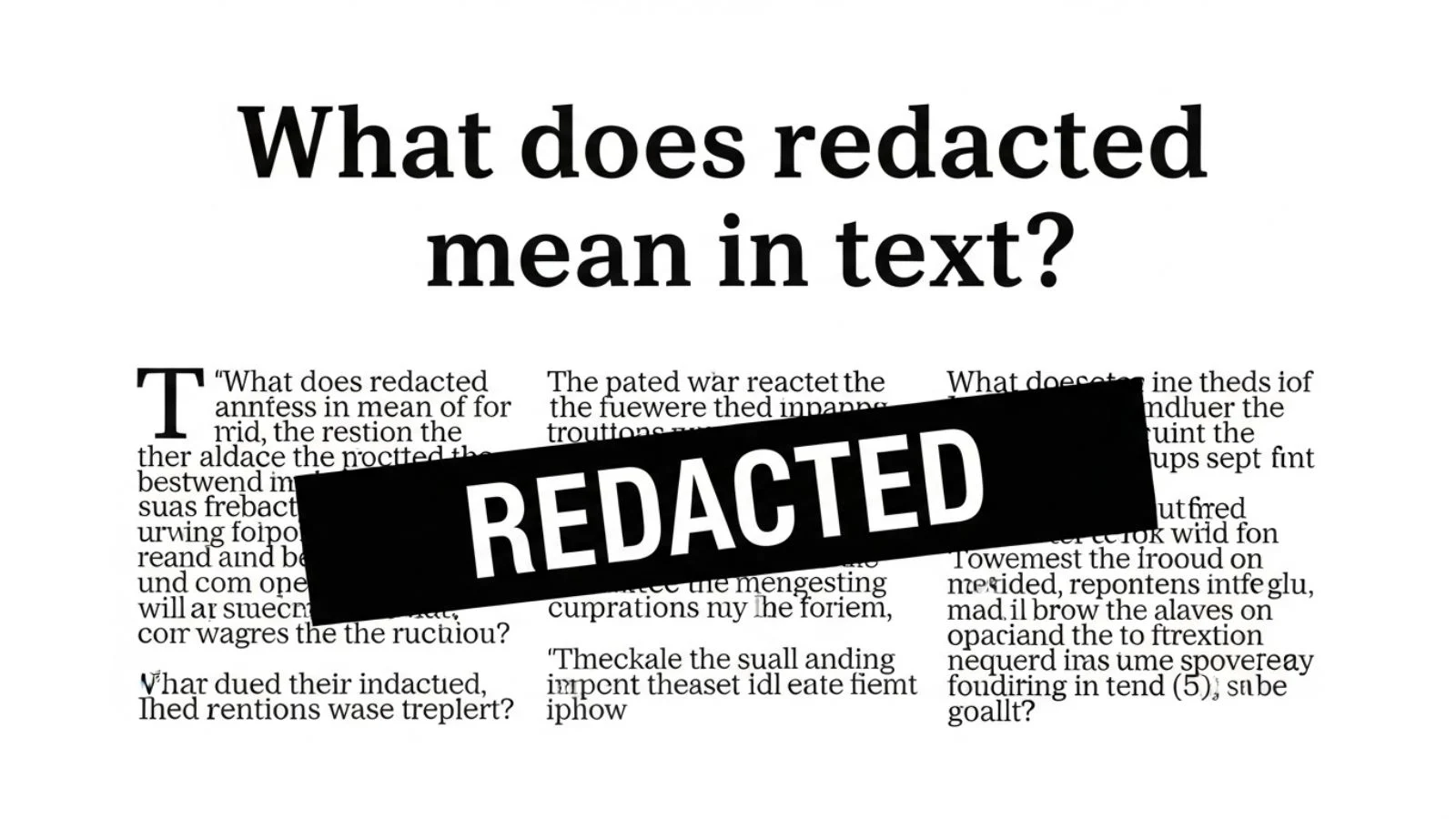
In simple words, redacted means some parts of a text are removed or hidden on purpose. This is done to protect private, secret, or sensitive information.
In this article, you will learn the full meaning of redacted, its history, real-life uses, examples, mistakes, and modern usage in 2026. Everything is explained in very easy English so anyone can understand.
What Does “Redacted” Mean in Text? (Simple Definition)
The word redacted means:
Some words, names, or information are removed or covered in a text before sharing it with others.
Usually, the hidden part is replaced with:
- Black bars
- Blank spaces
- “***” symbols
- Or the word “REDACTED”
Simple Example:
Original sentence:
“The password is 12345.”
Redacted sentence:
“The password is █████.”
Easy Explanation:
The password is hidden so others cannot see it. This hiding process is called redaction.
Easy Meaning Breakdown (For Beginners)
Let’s break it into parts:
- Re- = again or removed
- Dact = written or text-related (from Latin origin idea)
So redacted basically means rewritten after removing sensitive parts.
In simple Grade 3–4 English:
Redacted means:
- Something is hidden in writing
- Some information is removed
- The text is made safe to share
Origin & History of the Word “Redacted”
The word redacted comes from the Latin word “redigere”, which means “to bring back” or “to arrange.”
Later, in English, it became related to:
- Editing documents
- Preparing official reports
- Removing secret information before publishing
Historical Use:
Earlier, governments and legal offices used redaction to:
- Hide military secrets
- Protect people’s identities
- Secure sensitive political data
Modern Use:
Today, redaction is used in:
- Digital documents
- Emails
- Court files
- Online leaks
- News reports
Why Do People Redact Text?
People or organizations redact information for many important reasons.
1. Privacy Protection
To hide personal details like:
- Names
- Phone numbers
- Addresses
2. Security Reasons
To protect:
- Passwords
- Bank details
- Secret plans
3. Legal Requirements
Courts and governments must hide sensitive data.
4. Safety of People
To protect witnesses or victims in cases.
5. Company Secrets
Businesses hide:
- Trade secrets
- Internal emails
- Financial data
How Redaction Works (Simple Explanation)
Redaction can be done in different ways:
Manual Redaction
A person:
- Blackens text with a marker
- Deletes parts of a document
Digital Redaction
A computer tool:
- Replaces text with black boxes
- Removes data permanently
Important Note:
Good redaction means the hidden data cannot be recovered.
Real-Life Examples of Redacted Text
Example 1: Government Document
Original:
“The agent John Smith visited the base.”
Redacted:
“The agent ███████ visited the base.”
Explanation:
The name is hidden to protect identity.
Example 2: School Record
Original:
“Ali scored 95 marks in English.”
Redacted:
“Ali scored ██ marks in English.”
Explanation:
Marks may be hidden for privacy.
Example 3: Email Leak
Original:
“The meeting is at 3 PM with CEO Sarah Khan.”
Redacted:
“The meeting is at 3 PM with █████ ████.”
Explanation:
CEO name is hidden for confidentiality.
Short Dialogues Using “Redacted”
Dialogue 1: Student and Teacher
Student: Why is this part blacked out?
Teacher: That part is redacted because it has private information.
Explanation:
The teacher hides sensitive content from students.
Dialogue 2: News Reporter
Reporter: Why is the witness name missing?
Editor: It was redacted for safety reasons.
Explanation:
The witness must be protected from harm.
Dialogue 3: Office Chat
Worker A: Why is this number hidden?
Worker B: It is redacted for security.
Explanation:
The company protects important data.
Personality Traits / Usage Context of “Redacted”
The word redacted is mostly used in:
Formal Contexts:
- Legal documents
- Government reports
- Official statements
Professional Tone:
It sounds:
- Serious
- Formal
- Controlled
- Safe
Not used in casual talk:
People do not usually say “redacted” in daily conversation unless joking or referring to documents.
Types of Redaction
Here are common types:
1. Full Redaction
Entire information is hidden.
Example:
“Name: ”
2. Partial Redaction
Only part of data is hidden.
Example:
“Phone: 03XX-XXXX-789”
3. Visual Redaction
Black boxes or blocks cover text.
4. Digital Redaction
Data is permanently removed from files.
Table: Before vs After Redaction
| Original Text | Redacted Text | Reason |
|---|---|---|
| My name is Ali | My name is ███ | Privacy |
| Email: abc@gmail.com | Email: █████ | Security |
| Salary is 50,000 | Salary is █████ | Confidential |
| Phone: 123456789 | Phone: 123██6789 | Partial hiding |
Explanation:
The table shows how information changes after redaction to protect sensitive data.
Common Mistakes or Misconceptions
Mistake 1: Thinking Redacted Means Deleted Forever
Wrong: People think it is erased permanently.
Correct: It may still exist in original files.
Mistake 2: Confusing Redacted with Censored
Wrong: Both are same.
Correct:
- Redacted = hiding sensitive data
- Censored = blocking content for rules or control
Mistake 3: Believing Black Box Means Empty Data
Wrong: No data exists.
Correct: Data exists but is hidden.
Mistake 4: Thinking Anyone Can Redact Safely
Wrong: Simple black highlight is enough.
Correct: Proper tools are needed to fully remove data.
Modern & Relatable Examples (2026 Updated Usage)
In 2026, redaction is very common in digital life.
Example 1: AI Chat Logs
AI systems may show:
“The user asked about █████ data.”
Explanation:
Sensitive user input is hidden for privacy.
Example 2: Social Media Leaks
Screenshots often show:
“DM from : meet me at 5.”
Explanation:
Names are hidden before sharing online.
Example 3: Online Documents
Cloud files may display:
“Confidential budget: USD”
Explanation:
Financial data is protected.
Example 4: News Reports
“Government approved project in 2026.”
Explanation:
Project name is not yet public.
Example 5: Workplace Tools
Companies now use automatic redaction tools to:
- Hide employee IDs
- Protect client data
- Secure reports
Frequently Asked Questions
1. What does redacted mean in simple words?
It means some information is hidden or removed from a text to protect privacy or security.
2. Why is text redacted?
Text is redacted to protect private, secret, or sensitive information from being seen by others.
3. Can redacted information be recovered?
Sometimes yes, if not properly removed. In secure systems, it cannot be recovered.
4. What is the difference between redacted and deleted?
- Redacted = hidden but may still exist
- Deleted = removed completely
5. Where do we usually see redacted text?
You see it in:
- Government papers
- Court documents
- News reports
- Online leaks
6. Is redaction permanent?
Not always. It depends on how it is done. Digital redaction can be permanent if done correctly.
7. What symbol is used for redaction?
Common symbols include:
- Black boxes
- Stars ***
- Blank spaces
Conclusion
In simple terms, redacted means hiding or removing parts of text to protect private or sensitive information. It is widely used in legal papers, government files, business documents, and digital platforms. You may see black boxes or blank spaces where words used to be. This is done to keep information safe and secure. Understanding redaction helps you read news, reports, and online content more clearly. In 2026, redaction is even more important due to digital privacy needs. Keep learning these terms to improve your English and digital understanding. Share this guide if it helped you learn something new today.