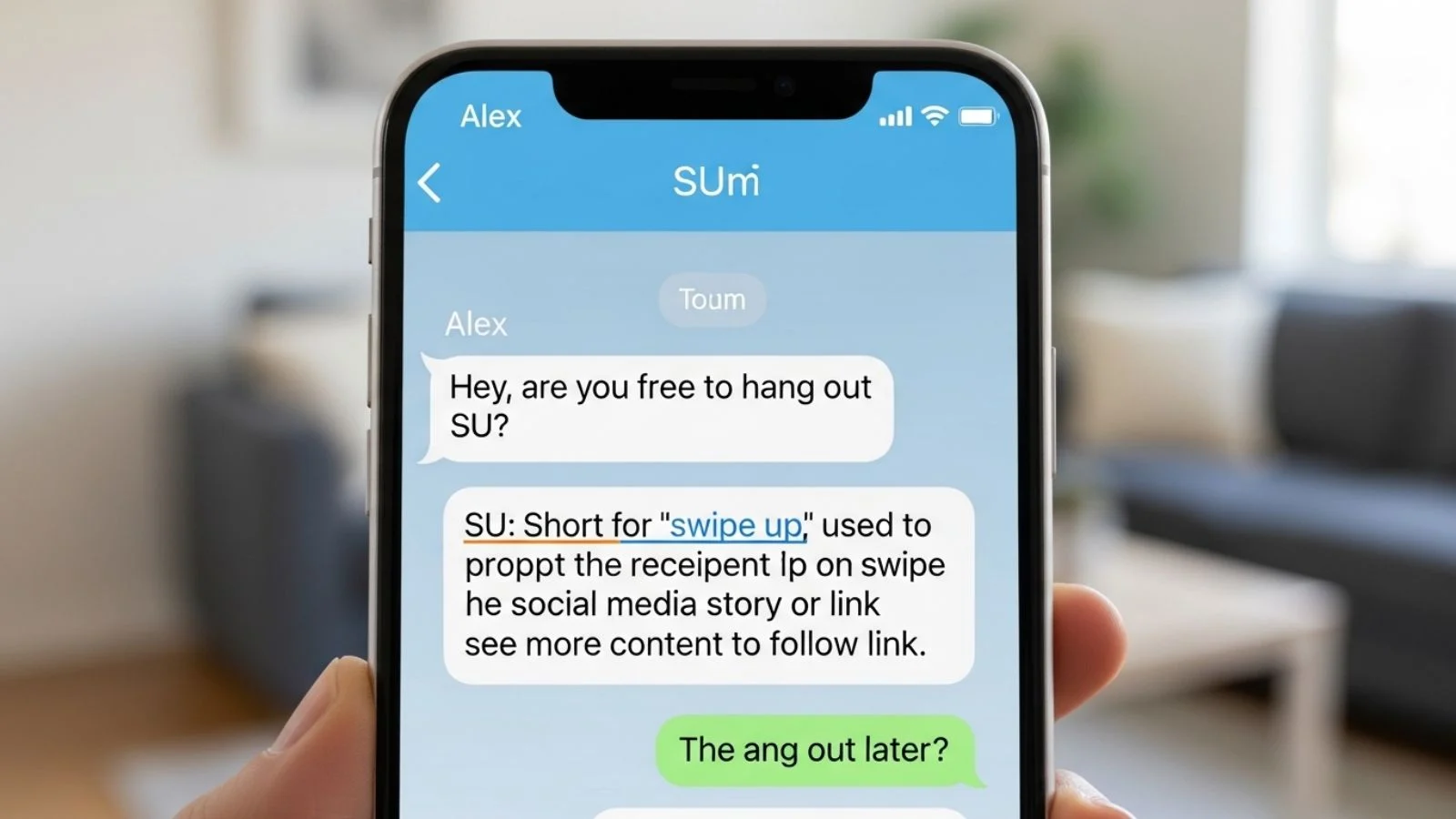
In most online chats, SU means “Shut Up.” It’s a short, informal texting abbreviation used to tell someone to be quiet — either jokingly, playfully, or sometimes rudely, depending on the tone.
But that’s not the full story.
“SU” can also mean different things based on context, platform, and relationship between the people chatting. Let’s break down everything you need to know about what dose SU mean in text, including tone, replies, and whether it’s rude.
SU Meaning in Text Explained Clearly
When people search for “what dose su mean in text”, they’re usually trying to understand a short message like:
- “SU lol”
- “Omg SU ”
- “Just SU already”
In texting slang, SU most commonly stands for “Shut Up.”
Is SU an Acronym or Slang?
SU is:
- An acronym
- A short form
- A fast-typing abbreviation
- Used mostly in informal chat
It is not a meme-based slang originally, but it has become popular in meme culture because of playful “shut up” reactions.
SU Meaning in Text Messages
In text messages, SU usually means:
- “Stop talking”
- “No way, shut up!”
- “Be quiet”
However, tone changes everything.
What Does SU Mean in Chat?
In online chat, SU slang meaning can be:
- Playful disbelief
- Sarcastic reaction
- Annoyed command
- Teasing response
Example:
A: I just won free concert tickets.
B: SU!!! No way!
A: I swear it’s real!
Here, SU expresses excitement and disbelief — not actual anger.
SU Meaning Across Social Media Platforms
Different platforms slightly change the tone.
SU Meaning on Snapchat
On Snapchat, SU usually means “Shut Up” in a playful or dramatic way.
Snapchat users often add emojis, making it less serious:
- “SU that’s crazy”
- “SU you’re lying”
Tone: Mostly dramatic or joking.
SU Meaning on TikTok
On TikTok comments, SU is used in reaction culture.
Example:
- “SU that glow up is insane”
- “SU you ate that”
Here, SU expresses shock or hype.
Tone: Over-the-top, dramatic, playful.
SU Meaning on Instagram
On Instagram DMs and comments, SU can be:
- Friendly teasing
- Reaction to surprising news
Example:
A: Guess who texted me?
B: SU who??
Tone: Curious or dramatic.
SU Meaning on WhatsApp
On WhatsApp, tone depends heavily on relationship.
Between close friends:
- Playful
Between acquaintances:
- Can feel rude
Example:
A: You forgot your wallet again.
B: SU
Tone: Friendly embarrassment.
SU Meaning in SMS (Regular Text Messages)
In SMS texting, SU is more direct.
Without emojis or context, it can feel harsher.
Example:
- “SU already.”
This may sound more aggressive.
Tone & Context Variations of SU
Understanding tone is critical.
1. Funny Tone
A: I tripped in front of everyone.
B: SU
A: I’m serious!
Meaning: That’s so embarrassing, wow.
2. Sarcastic Tone
A: I’m always right.
B: SU sure you are.
A: Haha okay.
Meaning: I don’t believe you.
3. Romantic Tone
A: You’re the cutest person ever.
B: SU stoppp
A: Never.
Meaning: I’m shy but happy.
4. Angry Tone
A: I told your secret.
B: SU.
A: Why are you mad?
Meaning: Stop talking. I’m upset.
5. Playful Tone
A: I ate your fries.
B: SU no you didn’t.
A: I did.
Meaning: I don’t believe you, jokingly.
15 Real Chat Examples of SU in Conversation
A: I passed the exam.
B: SU really??
A: He likes you.
B: SU
A: I’m moving abroad.
B: SU that’s huge!
A: I finished the whole pizza.
B: SU liar.
A: I’m quitting tomorrow.
B: SU you’re not serious.
A: I met a celebrity today.
B: SU who??
A: I’m late again.
B: SU of course you are.
A: You’re my favorite person.
B: SU stoppp.
A: I broke your mug.
B: SU…
A: I won the lottery.
B: SU send proof.
A: I’m taller than you now.
B: SU impossible.
A: I miss you.
B: SU come here then.
A: I dyed my hair pink.
B: SU I need pics.
A: I forgot your birthday.
B: SU that hurts.
A: I love pineapple pizza.
B: SU we can’t be friends.
Grammar & Language Role of SU
Part of Speech
SU functions as:
- An interjection
- A shortened imperative phrase
Original phrase: “Shut up” (verb phrase command)
Shortened form: “SU”
Sentence Role
It can:
- Replace a full sentence
- Act as a reaction
- Start a sentence
Examples:
- “SU.”
- “SU that’s wild.”
- “Omg SU.”
Formal vs Informal Usage
SU is:
- 100% informal
- Not appropriate in professional writing
- Casual and internet-based
Tone Impact
Without emojis, SU can seem rude.
With emojis:
- Less serious
- More dramatic
- More playful
Context matters more than the word itself.
How to Reply When Someone Says “SU”
Your reply depends on tone.
Funny Replies
- “Make me.”
- “Only if you stop first.”
- “You wish.”
- “Nope.”
- “Say please.”
Serious Replies
- “Why?”
- “Did I say something wrong?”
- “What happened?”
- “Are you upset?”
Flirty Replies
- “You like when I talk.”
- “Only if you kiss me.”
- “You’re cute when you say that.”
- “Make me then.”
Neutral Replies
- “Okay.”
- “Alright.”
- “Lol.”
- “My bad.”
Choose your reply based on relationship and mood.
Is SU Rude or Bad?
Is SU Rude?
It can be.
If used angrily, yes.
If used jokingly, no.
Is It Disrespectful?
With strangers or teachers, yes.
With close friends, usually not.
Is It a Bad Word?
No.
It’s not profanity.
But it can feel aggressive.
Can You Use SU in School?
Not recommended.
Teachers may see it as disrespectful.
Can You Use SU at Work?
Avoid it.
Use professional language instead.
Who Uses SU?
Age Group
Mostly:
- Gen Z
- Younger Millennials
Rare among older generations.
Regions
Common in:
- United States
- United Kingdom
- Canada
- Australia
- Global internet culture
Most Common Platforms
- Snapchat
- TikTok
- Instagram DMs
- Gaming chats
- Group chats
Origin & Internet Culture
SU originated as a typing shortcut for “shut up.”
It became more common due to:
- Fast texting culture
- Character limits
- Meme reactions
- Dramatic internet humor
There’s no clear single origin point.
It likely evolved naturally from early SMS culture in the 2000s.
Comparison Table: SU vs Similar Slang
| Term | Meaning | Formal/Informal | Tone | Popularity | Confusion Risk |
|---|---|---|---|---|---|
| SU | Shut Up | Informal | Playful/Angry | Medium | Medium |
| IDK | I Don’t Know | Informal | Neutral | Very High | Low |
| ion | I don’t | Informal | Casual | Medium | Medium |
| dunno | Don’t Know | Informal | Relaxed | High | Low |
| IDC | I Don’t Care | Informal | Cold/Neutral | Very High | Low |
SU is more emotionally charged compared to IDK or dunno.
Real-World Observation
In real group chats, SU is rarely meant seriously.
Friends often use it as a dramatic reaction — especially when reacting to surprising news.
However, when there’s tension in the conversation, SU can quickly escalate misunderstandings.
Tone and relationship matter more than the abbreviation itself.
Frequently Asked Questions
What Does SU Mean in Text Messages and Online Chat?
It usually means “Shut Up.” It can express shock, disbelief, teasing, or annoyance depending on tone.
What Does SU Mean on Snapchat and TikTok?
On Snapchat and TikTok, it’s mostly dramatic and playful. Users say SU when reacting to surprising or exciting content.
Is SU Rude, Disrespectful, or Harmless Slang?
It depends on context. Between friends, it’s harmless. In formal or serious conversations, it can sound rude.
How Should You Reply When Someone Says “SU”?
You can reply playfully (“Make me”), seriously (“What’s wrong?”), or neutrally (“Okay”) based on tone.
Is SU the Same as IDK or Different?
Different. SU means “Shut Up.” IDK means “I Don’t Know.” They serve completely different purposes.
Can You Use SU in School or Work?
It’s best to avoid using SU in professional or academic settings. It’s informal internet slang.
Conclusion
SU means “Shut Up” in text.
It is:
- Informal
- Tone-dependent
- Common among younger users
- Usually playful but can sound rude
Use SU When:
- Talking to close friends
- Reacting to shocking news
- Being playful
Avoid SU When:
- Talking to teachers
- Messaging coworkers
- In serious discussions
- When tone may be misunderstood
Common Mistakes
- Using SU without emojis in sensitive chats
- Sending it to someone who doesn’t understand slang
- Using it in professional messages
If you’re unsure about tone, spell out your reaction instead.
Now you fully understand what dose su mean in text and how to use it correctly in 2026.