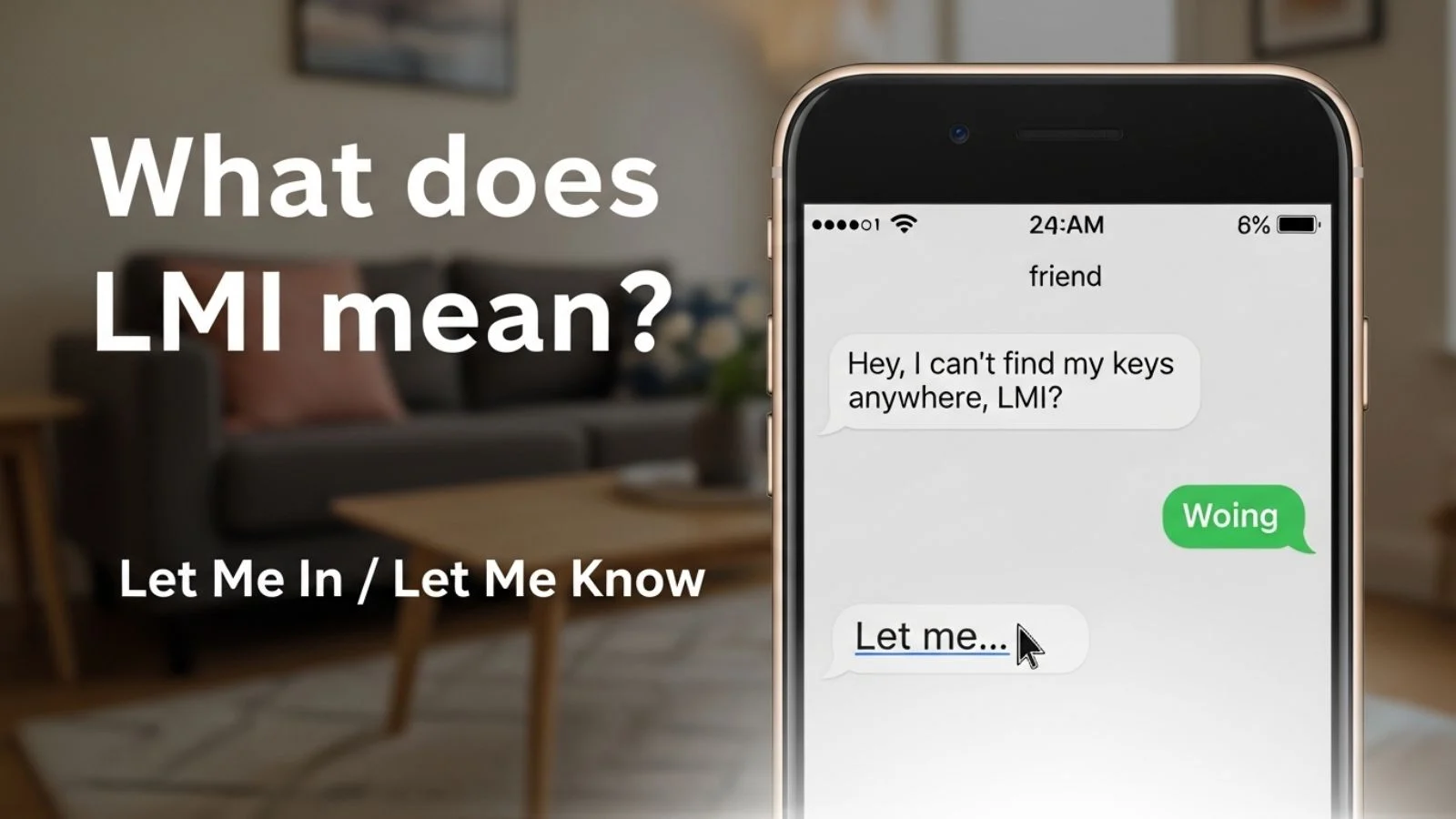
LMI means “Let Me In” in text messages and online chat. It’s a short, casual way to ask someone to include you in something—like a group chat, game, plan, or private conversation.
If you’ve seen someone comment “LMI” under a post or send it in a message, they’re usually asking to be added, invited, or involved.
Now let’s break down the full LMI meaning in text, how it’s used across platforms, tone differences, and how you should reply.
LMI Meaning in Text
The primary LMI meaning in text is:
LMI = Let Me In
It’s commonly used when someone wants access to:
- A private group chat
- A party or event
- A gaming session
- A secret conversation
- Exclusive content
For example:
A: We made a new group for the trip.
B: LMI.
A: Adding you now.
Simple. Direct. Informal.
Is LMI an Acronym or Slang?
LMI is:
- An acronym (first letters of “Let Me In”)
- A typing shortcut
- Informal internet slang
It is not:
- A meme-based phrase (though it can be used humorously)
- A phonetic spelling
- A replacement for a full sentence in formal writing
It’s strictly casual and mostly used in chat environments.
What Does LMI Mean in Chat?
When someone types LMI in chat, they’re usually asking:
- “Add me.”
- “Include me.”
- “Invite me.”
- “I want access too.”
It’s short and often slightly demanding, depending on tone.
Example:
A: We’re playing Valorant tonight.
B: LMI.
A: Bet, sending invite.
The tone is usually playful or casual, not aggressive.
LMI Meaning on Snapchat
On Snapchat, LMI usually appears:
- In private story replies
- Under exclusive story posts
- In group chat requests
Example:
A posts: “Private story going crazy tonight.”
B replies: LMI.
Here, LMI means “Add me to your private story.”
On Snapchat, the tone is usually playful or curious.
LMI Meaning on TikTok
On TikTok, LMI is often used in comments.
Example:
Creator posts: “Only close friends know what happened.”
Comment: LMI.
In this context, LMI means:
- “Tell me.”
- “Include me in the tea.”
- “Let me be part of it.”
It can also express curiosity or fear of missing out.
LMI Meaning on Instagram
On Instagram, LMI is common in:
- Close friends story requests
- Private account access
- Exclusive content comments
Example:
A posts: “New spam account.”
B comments: LMI.
It means “Add me to it.”
Tone on Instagram is usually casual and friendly.
LMI Meaning on WhatsApp
On WhatsApp, LMI is more direct.
Example:
A: We created a separate wedding planning group.
B: LMI.
Here, it’s a clear request to be added.
Tone on WhatsApp is usually practical rather than playful.
LMI Meaning in SMS (Text Messages)
In regular SMS, LMI still means “Let Me In,” but it’s less common than on social media.
It may appear in:
- Event invites
- Group chat creation
- Gaming invites
Older generations are less likely to use it.
Tone & Context Variations
Even though LMI has one core meaning, tone changes everything.
1. Funny Tone
A: We’re forming a secret pizza club.
B: LMI before I expose y’all.
A: Relax, you’re in.
Used jokingly.
2. Sarcastic Tone
A: Only smart people understand this.
B: LMI I guess.
A: You barely qualify.
Here it’s playful sarcasm.
3. Romantic Tone
A: I only show this side to special people.
B: LMI then.
A: Maybe you earned it.
Slightly flirty.
4. Angry Tone
A: We made another group without you.
B: LMI.
Short. Dry. Possibly annoyed.
5. Playful Tone
A: VIP section only.
B: LMI.
A: Say please.
B: LMI please.
Light and fun.
15 Real Chat Examples of LMI
- A: Private story dropping tonight.
B: LMI. - A: We’re playing GTA.
B: LMI. - A: Made a new spam account.
B: LMI. - A: Secret study group.
B: LMI fr. - A: Family group only.
B: LMI I’m basically family. - A: Only gym members allowed.
B: LMI I pay mentally. - A: VIP party tonight.
B: LMI. - A: We have tea to spill.
B: LMI immediately. - A: New Discord server.
B: LMI. - A: Inner circle only.
B: LMI. - A: Movie night at mine.
B: LMI. - A: We made a meme page.
B: LMI. - A: Secret Santa list done.
B: LMI. - A: Afterparty invite only.
B: LMI. - A: Private playlist.
B: LMI.
Grammar & Language Role of LMI
Part of Speech
LMI functions as a sentence-level acronym.
It replaces the full sentence:
“Let me in.”
Sentence Role
It acts as:
- A command/request
- An imperative statement
It does not function as a noun or adjective.
Sentence Position
Usually used:
- Alone as a full message
- At the end of a sentence
Example:
“That looks fun, LMI.”
Formal vs Informal Usage
LMI is strictly informal.
Do not use it in:
- Emails
- Academic writing
- Professional meetings
Tone impact:
- Casual
- Direct
- Sometimes slightly demanding
How to Reply When Someone Says “LMI”
Your reply depends on context.
Funny Replies
- “Application denied.”
- “Say the magic word.”
- “Only if you bring snacks.”
- “You sure you’re ready?”
Serious Replies
- “Sure, I’ll add you.”
- “Sending invite now.”
- “You’re in.”
- “Done.”
Flirty Replies
- “Maybe… convince me.”
- “Why should I?”
- “You think you deserve it?”
- “I was waiting for you to ask.”
Neutral Replies
- “Okay.”
- “Adding you.”
- “Check your notifications.”
Is LMI Rude or Bad?
Is LMI rude?
Not inherently.
It can sound demanding if used without context.
Is it disrespectful?
No. But tone matters.
Typing just “LMI” without politeness can feel abrupt.
Is it a bad word?
No. It’s harmless slang.
Can you use it in school?
In casual chat with classmates, yes.
In essays or formal writing, no.
Can you use it at work?
Not recommended unless:
- You’re in a casual team chat
- You know your workplace culture allows slang
Otherwise, say:
“Could you add me to that group?”
Who Uses This Term?
Age Group
Mostly:
- Gen Z
- Younger Millennials
Teens and people in their early 20s use it the most.
Regions
Common in:
- United States
- UK
- Canada
- Global English-speaking internet
It spreads through TikTok and gaming culture.
Most Common Platforms
- Snapchat
- TikTok
- Discord
- Gaming chats
Less common in professional environments.
Origin & Internet Culture
LMI likely emerged from:
- Fast typing culture
- Group chat culture
- Private story trends
As social media created more exclusive spaces, people needed quick ways to request access.
There is no confirmed viral origin moment.
It grew naturally through online abbreviation habits, similar to:
- IDK
- ILY
- BRB
It reflects modern internet culture where speed and brevity matter.
Comparison Table
| Term | Meaning | Formal/Informal | Tone | Popularity | Confusion Risk |
|---|---|---|---|---|---|
| LMI | Let Me In | Informal | Direct | Moderate | Medium |
| IDK | I Don’t Know | Informal | Neutral | Very High | Low |
| ION | I Don’t | Informal | Casual | Medium | Medium |
| Dunno | Don’t Know | Informal | Relaxed | Medium | Low |
| IDC | I Don’t Care | Informal | Dismissive | Very High | Low |
LMI is more situational than IDK or IDC.
Real-World Usage Insight
In real conversations, LMI often appears when someone feels slight FOMO (fear of missing out).
People rarely type the full phrase “let me in” anymore in casual chat. LMI feels quicker and socially aligned with how Gen Z communicates.
It’s short, slightly bold, and assumes closeness.
That’s why tone and relationship matter.
Frequently Asked Questions
What Does LMI Mean in Text Messages and Online Chat?
It means “Let Me In.” It’s a short request to be included, added, or invited to something.
What Does LMI Mean on Snapchat and TikTok?
On Snapchat, it usually means “Add me to your private story.”
On TikTok, it often means “Include me” or “Tell me the details.”
Is LMI Rude, Disrespectful, or Harmless Slang?
It’s harmless slang. It can sound abrupt if used alone, but it’s not offensive.
How Should You Reply When Someone Says “LMI”?
You can:
- Add them
- Joke back
- Ask why
- Ignore if inappropriate
Your tone sets the vibe.
Is LMI the Same as IDK or Different?
Different.
IDK means “I Don’t Know.”
LMI means “Let Me In.”
They serve completely different purposes.
Can You Use LMI in School or Work?
In casual chat with friends, yes.
In professional emails or formal communication, avoid it.
Conclusion
LMI means “Let Me In.” It’s an informal acronym used to request access, inclusion, or invitation.
Use it when:
- Talking with friends
- Commenting on social media
- Requesting group access
- Gaming or private chats
Avoid it when:
- Writing emails
- Talking to teachers formally
- Communicating in professional settings
Common mistakes:
- Using it with people who don’t understand slang
- Sounding demanding without context
- Using it in formal writing
If you’re unsure, just type the full sentence.
Slang should make communication easier, not confusing.